Sunday, April 16, 2006

Weekend Photos

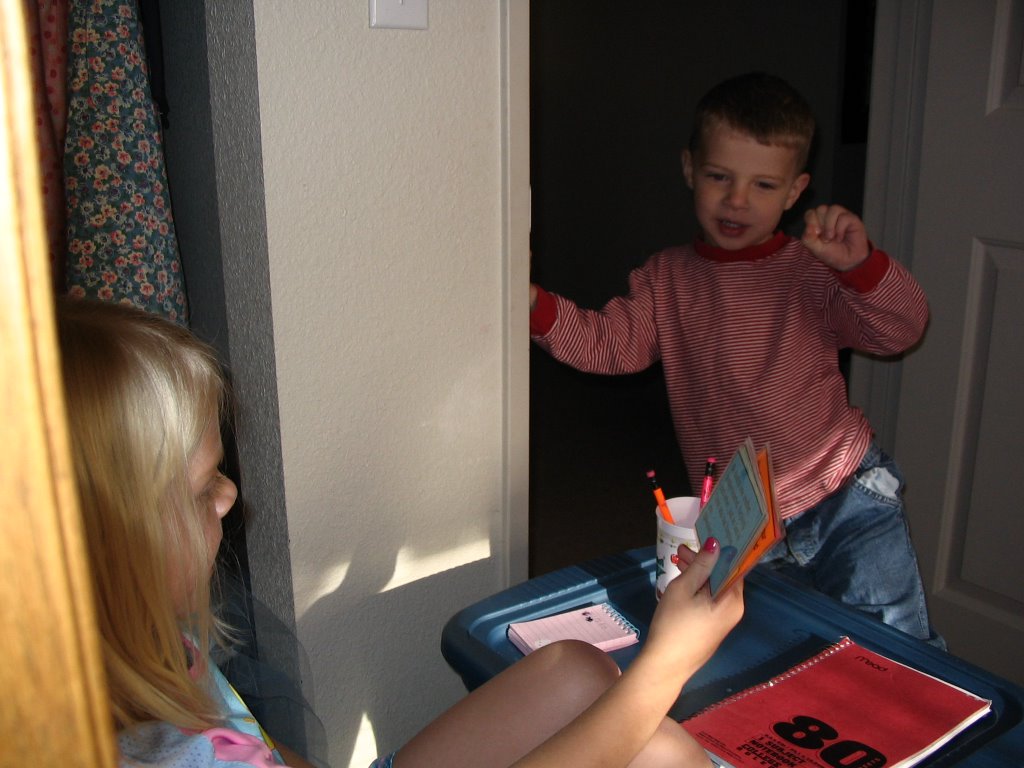
What a weekend! Good Friday service, neighborhood Easter Egg hunt on Saturday, Easter service this morning and a family hike in the Manzano Mts this afternoon. Here are a few pix.



Saturday, April 15, 2006

A Challenge to Women

Good, stout words from John Piper for women seeking godliness.

While I'm on the subject, Kristin recently finished reading a book I gave her, Faithful Women and Their Extraordinary God, by Noel Piper. Biographies can be very helpful, but there are really too few about godly women of the past. This book profiles five ordinary women—Sarah Edwards, Lilias Trotter, Gladys Aylward, Esther Ahn Kim, and Helen Roseveare—who trusted in their extraordinary God as he led them to do great things for his kingdom. Kristin recommends it!

Friday, April 14, 2006

A Gospel-Leavened World

Many of us in the Department of Defense were released from work early today. Why? Because it's Easter weekend of course. But you'll never hear that officially stated. Instead the real reason will have a cover story or, like today, there will be no reason given, just "go home!"

This reveals the leavening effect of the gospel. It has worked through the whole dough of our culture and despite attempts to cover it up, there are areas in our cultural life where it will always poke through.

Another example of this is the silliness of replacing B.C. with B.C.E. The incarnation is too world-transformative to be hidden with such a thin veneer.

Thursday, April 13, 2006

Bribed?

You will hear everlastingly that the rich man cannot be bribed. The fact is, of course, that the rich man is bribed; he has been bribed already. That is why he is a rich man. The whole case for Christianity is that a man who is dependent upon the luxuries of this life is a corrupt man, spiritually corrupt, politically corrupt, financially corrupt." G.K. Chesterton, Orthodoxy


I've read recently that 16,000 pastors leave the ministry every year. The pastor that discipled me as a new Christian is now out of the pastorate; he's working for a parachurch group and has a title of "church planting coach." I know enough about the finances of church planting to know he's probably not going to get rich in this position.

But he made that decision a long time ago. He left a good-paying job in corporate America, and with 4 children at home became a church-planting pastor for the PCA. Over the course of the last 15 years that church grew but apparently has shrunk back to meeting in a hotel lobby, his first grandchild was born severely handicapped, and his wife died a slow, painful death.

Other pastors I've known have also dared to give up wealth in exchange for a hard life in the ministry. Compared to them, I'm taking the bribe. The main reason why I plan to stay in my current good-paying job is because it's a guaranteed paycheck and in several years I can retire and draw lifetime benefits. Yet, I get praised by strangers for "serving my country" while pastors quietly serve a flock who gives more scorn than thanks.

Chesterton's judgment is just; I am corrupt and in need of courage to reject the bribe.

Monday, April 10, 2006

Dis-ease

These have been joyless days. Dawn to dusk spent correcting children stuck in a cycle of behavior that is either mean or foolish. Ending the day exhausted and guilt-ridden knowing I exasperated my oldest son again. Haunted by the law, I will reap in him what I sow. Nights with a fussy baby. Ambiguous expectations at work. My cup runs over with frustration, and it spills all over my wife.

The grass looks greener everywhere else. Maybe a life of ease really is the good life? But I am reminded--the will of God is to sanctify me, and seldom is that done through times of ease. I am to focus on God's mercy and not the afflictions.

Full-bodied forgiveness. Faith falling asleep in my arms. A sermon last Sunday so Christ-full, it brought tears. 3-on-1 wrestling matches on the carpet with my children. A selfless wife. This is the good life. Simple, free, purposeful.

Saturday, April 08, 2006

O Happy, Happy Day--the Vernal Equinox Approaches!

The government schools around here have next Friday off. The school sign gives the reason for the day-off, but it doesn't say "Good Friday." And it seems that naming "Easter" has become too risky these days. (Of course Resurrection Day is plainly out). No, the school signs along the road announce that this day off is to celebrate "Vernal Holiday." Again I suffer the consequences of a sheltered childhood, I ashamedly admit my ignorance of such an important holiday.

A quick wikipedia serach reveals this is not the purely secular term that I suppose the school board was hoping for. According to the ancient Persian (remember our friend Iran?) mythology this holiday recalls the myth of creation and the ancient cosmology of Iranian and Persian people.

Also, the vernal equinox is the most significant day in the pagan calendar, and some pagans spend the day praying to the goddess of cats, Bast. Not to be left out, the Wiccan Sabbat of Ostara (or Eostar) is also celebrated on this day.

So remember that when you see children out of school this Friday that it's not because their families are thinking of Christ's death and resurrection, but (wink, wink), it's Happy Vernal Day!

Thursday, April 06, 2006

You, too, could be God

I had another lunch with my Mormon co-worker, Mark; we only have a little more than a month before he is reassigned to a different base, so I'm glad to have these opportunities to speak with him.

There is humor in our situation. Both Mark and I believe that only the Holy Spirit can cause the other fellow to change sides, neither of us seem willing to abandon hope for a conversion, and we're both trying to be good ambassadors for our respective God. But so far there is no indication of a defection either way. Instead we each present arguments for our position that we expect to clinch the dispute, only to find the other side nonplussed.

Mark thinks that I should find it very appealing that I too could be fully God someday, and that even now I could be part of a "primitive" church with prophets and Apostles receiving direct revelation from a God who still has things to say to His people.

I, on the other hand, think Mark should lose sleep over his low view of God, his insulting assertion that the Holy Spirit didn't speaking clearly enough for the Bible to be reliable, and the strong possibility that Joseph Smith and his followers have been deceived by Satan's masquerades as an angel of light.

Surprisingly our discussions are irenic, and I still pray to be faithful at planting gospel seeds in his life. We meet again next week to discuss the process Mormons use to canonize "continued revelation".

Tuesday, April 04, 2006

The Christian Talmud

I'd like to know more about the oral tradition of the Jewish faith, with its innumerable regulations of do's and don't's, and how it came to be the rule for faith and practice. I'm told the Talmud has some rather interesting things to say about salvation, such as "he who recites Psalm 145 three times a day will have eternal life." (Pesahim 113a)

Now here's the question I want to get to...have we built our own "Christian Talmud", full of non-revelatory opinions that define who really is a Christian? You would think we have when you listen to the interviews that White Horse Inn conducted during the Christian Bookseller's Association.

It seems that Americans know better than Paul; down deep in our heart-of-hearts we're really good, God knows this and loves us for it. And a Christian is not so much characterized by continuing repentance and faith in Christ, but by a constantly changing list of "Christian fads" and religious-jargon.

Sunday, April 02, 2006

The Importance of Insignificance

Most men search for significance, in their career, sports, possessions or even church. There's a popular Christian book by that title that has sold over 2,000,000 copies. This can be an unhealthy quest, by definition very few will ever find significance in any area.

I occasionally find strange things to be thankful for. Baldness is good because it probably helps me stay maritally faithful. Likewise, insignificance chokes pride. If I were to gain renown in some area my problems with pride would undoubtedly only worsen.

So if insignificance can be a good thing, how do we resist the temptation to make a name for ourselves? The search for insignificance ends in the presence of God. Calvin says, "men are never duly touched and impressed with a conviction of their insignificance until they have contrasted themselves with the majesty of God."

Saturday, April 01, 2006

Ear Gate Update

If you like edifying and enjoyable MP-3 type audio programs, I'll briefly recommend a couple I've started listening to recently.

Al Mohler's podcast, despite having theme music that reminds one of Bob the Builder, is my new favorite podcast. He provides up-to-date cultural news and analysis from an uncompromising, biblical worldview. To get a good flavor of this show, listen to this one

Ordinary Means has put out three episodes so far and is helping me better understand and articulate to others why the Word, the Sacraments, and prayer are all we need to grow in the Christian life.
Elapsed Time and Real Growth

We welcomed two families from our Ohio assignment and church to Albuquerque this week. They're moving in just down the street from us!

The last year has brought about substantial changes in our families--more children, less hair--very obvious stuff like that. Is our growth in Christ over the last year as obvious? Elapsed time should be a good measure of real growth.

After dinner we spent some sweet time in worship together; the children making prayer requests for babies-in-tummies, the adults sweetening spring-time air with some psalm-singing in harmony.

I've been thinking lately about whether I understand sanctification properly and was edified by what my friend had to say about it. I asked for a recommendation on the "definitive" book on this topic; he recommends J.C. Ryle's Holiness.

Since there are so many books that folks say are "must reads," I've learned to usually wait until three people recommend the same book to me before I make time for it. A couple other folks have mentioned this book from time to time; if any of my readers have thoughts on Ryle's, or other books on sanctification, I'll appreciate reading them.

Tuesday, March 28, 2006


Hospitality Has Its Limits

In our family worship we have been reading through Romans. Tonight after I read the end of the first chapter about the gossips, slanderers, haters of God, etc, my 3-year old son announced, "I don't want them to come to my house!"

Sunday, March 26, 2006

Jemez Falls, NM

After worship today we drove up to the Santa Fe National Forest. It was 72 degrees when we left Albuquerque, but two hours north it was only 50 degrees in the Jemez Springs area. We forgot to pack for the temperature change but fortunately Kristin had a bag of girls clothes for goodwill in the trunk. So the Bailey boys were stylin' in a strange way, but warm.


Our dog, Glory, takes the polar bear challenge


This is the overlook to a large waterfall that was mostly frozen over.


We're now at the top of the waterfall.

Saturday, March 25, 2006


Help for Distressed Parents

There is solid help for parents in this old, 36-page book; more than you'll find in much better publicized and lengthier books of today. I read this yesterday during the flight home from D.C.

The original title was much more provocative, "Counsels and Comforts for Godly Parents Afflicted with Ungodly Children." I'll structure this brief review around the key words in that title.

Mather has a test to see if you are indeed a godly parent. Godly parents are more afraid of their children being ungodly than of their being in any other way unhappy. They are afflicted for their children's contrariness unto God more than anything else. Ungodly parents, on the other hand, though the souls of their children are altogether unacquainted with the ways of God, care only that their child be dressed up in a few idle gaieties and, perhaps, some useless accomplishments (see Job 21:11, 14).

His counsel to godly parents is to remind them that their own original sin is written with deleted characters in all the ungodliness of their children. Much of the parents' actual sin can likewise be read in the children's ungodliness. Godly parents are not to forget that persons with uncircumcised hearts are born of such as had themselves experienced a circumcision of God upon their hearts.

More specifically, Mather counsels godly parents to single out the Scriptures which plainly condemn their vices and have the children read those awful Scriptures. Then charge them that, since they will answer before God, they conform themselves accordingly.

Don't humor your children with vanities that appeal to an unrenewed heart. Be as ingenious as possible at making a thorn hedge against every way of sinning attractive to your child. Be especially careful of the company they keep.

Most importantly, remember that distressed parents of old brought their diseased and disabled children unto the Lord Jesus Christ, and He healed them all. Thus, go plead before the Lord!

Have you done all this? Then do not despair, though you do not presently reap the fruit of all, delays are not denials!

Thursday, March 23, 2006

They're Merciful to Us

A big blog thanks to Cody and Erika Steele for graciously watching our children tonight so Kristin could enjoy a breather. I'm on the road and have been for most of the last three weeks. Thanks to Christian friends like the Steeles my wife has not yet been driven to desperation! Thank you for nurturing my family with your deeds of love.
Church Is For Losers

The recently deceased and much missed Edmund Clowney wrote The Church as part of a recent theological series called Contours of Christian Theology. It pleases me that the series editor gave such an important topic to a reformed Presbyterian. I finished it this week while on a trip to D.C. My favorite line was,
It [the Church] is composed of losers -- those who have lost everything for Christ's sake, but have found everything in him

This book is largely a scholarly and wide-ranging apologetic against an onslaught of attacks brought against the church today. But Clowney handles wolves on all sides with the composed manner of a mature shepherd. As he says, "love cannot ignore the seriousness of error, but neither can it forget the power of the truth."

Clowney honed my understanding of the Gospel and how it informs personal holiness. Instead of thinking of holiness in "try harder" or pietistic terms, he says,

The life of holiness is the life of faith in which the believer, with a deepening knowledge of his own sin and helplessness apart from Christ, increasingly casts himself upon the Lord, and seeks the power of the Spirit and the wisdom and comfort of the Bible to battle against the world, the flesh, and the devil. It is not a lonely struggle, for Christ gives the Spirit to the members of his body to help one another. Growth in true holiness is always growth together; it takes place through the nurture, the work, and worship of the church.


If you'd like to be better armed against false teaching, you need to read this one.

Tuesday, March 21, 2006

Burn and Break

"Is not my word like fire, declares the Lord, and like a hammer that breaks the rock in pieces?" Jer 23:29

Hardened by the deceitfulness of sin
Empty, cold, dull.
Adulterous, apathetic, unbroken
Rock, unfeeling, loveless
Thankless, proud, Diotrephes-incarnate.

Such is my heart in Your sight.

Raging fire, slash and burn,
Hammer of God, bash and turn
until with my whole heart I seek thee!

Sunday, March 19, 2006

The Hidden Joys of Child-Rearing

Time for a myth-buster. Some Christian couples put off having children because they're told that children will radically change their life. They imagine having to give up comfortable lifestyles and personal pleasures. They observe other parents obsessing over their children, seemingly unable to think, talk, or do anything unrelated to the kiddos. Here's the myth: your life stops the moment your child's starts.

I bust this myth everytime I have to leave my family. One of the unexpected, hidden joys of child-rearing is how it focuses my private time on what really counts. When away on a trip I have a much harder time pulling off private worship and my personal reading really drops off. I waste too much of these free evenings passively watching TV or surfing the web.

But when at home and the kids are in bed I know I have only a limited amount of time and it disciplines me to make the most of it. And I believe as a result of more time in the Word, private prayer, and useful reading, God brings about growth that otherwise would not have come.

So I think parenting young children offers naturally lazy people like me a forcing function to make those early morning and late evening hours count. Rather than giving up your life, this season of life can help you to cut out the wasted time, thereby redeeming it for more useful purposes.

And lastly, this may also uncover idols of the heart. If you only have an hour or two to yourself each day it's likely that what you run to during that time is your god. When a deer pants for water, it goes where it can be satisfied. So do we. Do we run to Him, and the thoughts of Him, even with the remains of the day?

Saturday, March 18, 2006

Wingmen

Yesterday most of my team enjoyed a day out of the office to focus on being better wingmen to each other. We literally put our lives into each others' hands throughout our day of rockclimbing at Socorro (about an hour south of Albuquerque). It's a privilege to lead such a great team of men.


Thursday, March 16, 2006

Downsizing Hell

Did you know that religious women are having many times more babies in America than secular women?

First Things' contributor Michael Novak explains the mega-trend in a recent post, but to get this you'll need to put your math hat on for a moment. "Nearly a quarter of the children of baby boomers descend from the mere 11 percent of baby boomer women who had four or more children."

Also, consider the demographics of France. "Among French women born in the early 1960s, less than a third have three or more children. But this distinct minority of French women (most of them presumably practicing Catholics and Muslims) produced more than 50 percent of all children born to their generation, in large measure because so many of their contemporaries had one child or none at all."

Forgive me for the overly provocative title on this post; just because religious folks are having more children than secular ones doesn't mean hell's population growth will slow down. But as Dr. Rayburn points out in his article on covenant succession, "Christian parents do not imagine themselves to be populating hell when they bring sons and daughters into the world!"

So in some sense, one way that this earth can become more like the kingdom of Christ and less like the kingdoms of this world is for this trend to continue.

Wednesday, March 15, 2006

Hymns for Dummies

When Kristin was planning our wedding she asked what music I would like for the prelude and closing of the service. As a new Christian, I wanted hymns. The problem was I knew next to nothing about them. If memory serves, I picked The Old Rugged Cross, Amazing Grace, and Blessed Assurance. This exhausted my knowledge of hymns. Kristin was gracious and honored what I now view as pretty tacky for a wedding.

How does one overcome such hymnody illiteracy? One way is to make them more accessible, which is basically the idea behind the Indelible Grace CDs.

When I borrowed a couple Indelible Grace CDs from a friend several years ago, I couldn't stand them. But now I listen to them almost everyday. I wouldn't necessary enjoy them during corporate worship, but they can fan into flame moments of personal worship.

I remember a pastor saying that every couple hundred years the Church makes a good hymn. Indelible Grace helps introduce them to poor illiterates like me. Here are the lyrics to one that I've recently grown to love (it's on the lastest CD).

“I Asked the Lord That I Might Grow”

I asked the Lord that I might grow
In faith, and love, and every grace;
Might more of His salvation know,
And seek, more earnestly, His face.

’Twas He who taught me thus to pray,
And He, I trust, has answered prayer!
But it has been in such a way,
As almost drove me to despair.

I hoped that in some favored hour,
At once He’d answer my request;
And by His love’s constraining pow’r,
Subdue my sins, and give me rest.

Instead of this, He made me feel
The hidden evils of my heart;
And let the angry pow’rs of hell
Assault my soul in every part.

Yea more, with His own hand He seemed
Intent to aggravate my woe;
Crossed all the fair designs I schemed,
Blasted my gourds, and laid me low.

Lord, why is this, I trembling cried,
Wilt thou pursue thy worm to death?
“’Tis in this way, the Lord replied,
I answer prayer for grace and faith.

These inward trials I employ,
From self, and pride, to set thee free;
And break thy schemes of earthly joy,
That thou may’st find thy all in Me.”

John Newton, 1779

Tuesday, March 14, 2006

The Sting of Little Things

Why is it that little things can hurt so much? My pastor's wife says she has no trouble believing that major trials in life are from God and for her good, but little pains and everyday vexations really get her down. She's right.

Today our little thing is neighbor issues. One neighbor called and said that their children can't go with us to church anymore because they don't want their children learning the catechism. My children are hurt by this the most; they loved having friends at church with them on Wednesday nights. It also makes Kristin and I feel like cultists.

Another neighbor quit homeschooling today and backed out of a minor commitment to us. I don't know why this bugs us. I guess in someway the homeschooling families of my neighorhood are interconnected, and when one leaves the path that we've also chosen, we're tempted to question anew whether we're doing the right thing in homeschooling.

I rest in this: "This I know, God is for me." (Psalm 56:9)
Talking to My Windshield

I'm in Seattle for a couple of meetings with Boeing and I ran into my Mormon co-worker that I've mentioned in previous posts. He needed a ride around town and so we spent an hour together this evening negotiating Seattle traffic.

I've been praying for something like this. During our time together I was able to stammer through a presentation of the Gospel according to the Bible (again) and piece together an argument for why direct revelation ceased with the close of the biblical canon.

I do not consider persuasion one of my gifts, and trust that God can not only work through my many weaknesses, but despite them! Yet, as far as I could tell, I was talking to my windshield.

Gotta think how patient God is with me and 'go and do likewise.'

Monday, March 13, 2006

Saying 'Peace', 'Peace', When There is no Peace

During the Ligonier conference Max McLean presented a sermon from George Whitefield called Method of Grace. Read the link if you long to hear a singularly pure Gospel presented with immense feeling and earnestness.

I've posted the following excerpt because it's one of my favorite Gospel themes. We, saved by grace, are prone to wander back to a covenant of works.

When a poor soul is somewhat awakened by the terrors of the Lord, then the poor creature, being born under the covenant of works, flies directly to a covenant of works again.

And as Adam and Eve hid themselves among the trees of the garden, and sewed fig leaves together to cover their nakedness, so the poor sinner, when awakened, flies to his duties and to his performances, to hide himself from God, and goes to patch up a righteousness of his own.

Says he, I will be mighty good now -- I will reform -- I will do all I can; and then certainly Jesus Christ will have mercy on me. But before you can speak peace to your heart, you must be brought to see that God may damn you for the best prayer you ever put up; you must be brought to see that all your duties -- all your righteousness -- as the prophet elegantly expresses it -- put them all together, are so far from recommending you to God, are so far from being any motive and inducement to God to have mercy on your poor soul, that he will see them to be filthy rags, a menstruous cloth -- that God hates them, and cannot away with them, if you bring them to him in order to recommend you to his favor.

My dear friends, what is there in our performances to recommend us unto God? Our persons are in an unjustified state by nature, we deserve to be damned ten thousand times over; and what must our performances be? We can do no good thing by nature: "They that are in the flesh cannot please God." You may do many things materially good, but you cannot do a thing formally and rightly good; because nature cannot act above itself.

After we are renewed, yet we are renewed but in part, indwelling sin continues in us, there is a mixture of corruption in every one of our duties; so that after we are converted, were Jesus Christ only to accept us according to our works, our works would damn us, for we cannot put up a prayer but it is far from that perfection which the moral law requireth.

I do not know what you may think, but I can say that I cannot pray but I sin -- I cannot preach to you or any others but I sin -- I can do nothing without sin; and, as one expresseth it, my repentance wants to be repented of, and my tears to be washed in the precious blood of my dear Redeemer. Our best duties are as so many splendid sins.

Sunday, March 12, 2006

Jesus, the Bearded Woman

A great post from my pastor from a previous assignment.

Friday, March 10, 2006

In Brief: Bought With a Price, Day 2

Today was the full day of the Ligonier conference on the Church. As I spoke with people during breaks I was reminded that the Holy Spirit, like a master surgeon, skillfully cuts with the Word according to each person's needs. Parts of the messages that were not particularly impacting to me were invaluable to others. In some sense, the Holy Spirit must individually-wrap each part of the preached Word and personally deliver this bundle of presents to individuals according to their exact need.

I was very impressed with John MacArthur's message on the shepherd and his flock. I regret largely ignoring his ministry in the past. Best line: "A good shepherd is not known by how well he pets the sheep; a good shepherd is to be known by how well he protects the sheep." In the context of his message, this statement packed a big punch.

Lig Duncan spoke on the Invisible Church and warned that those who deny the distinction between the visible and invisible aspects of the Church downplay the sovereignty of the Holy Spirit.

Ken Jones spoke on One Body, Many Parts; he gave two crisp reasons why a Christian must be part of a local church. First, to withhold your presence denies the church access to one of the gifts that God has supplied the church; and second, you are denying yourself access to the gifts of others.

Sinclair Ferguson presented the Church's Message giving powerful illustrations of the gospel. For example, until now I had never seen the beauty of the gospel in the arm-crossed blessing Jacob gives Ephraim and Manasseh. The father's right hand ought to rest on the rightful elder brother, but no, graciously the hand of blessing is given to the other.

Lig Duncan spoke on the Church's Mission in a Piper-esqe way emphasizing that missions exist because worship doesn't. Missions is not the goal of the church, worship is.

Mixed into the day's agenda was a hard-heart-busting presentation of a George Whitefield sermon by Max McLean, 3 small-group prayer meetings, a soul-awakening musical concert, and part one of a Q&A.
What I "Bought With a Price"

Here's what I picked up at the Ligonier Conference bookstore:

The Rise and Progress of Religion in the Soul (Philip Doddridge, 1745)

Help for Distressed Parents (Cotton Mather, 1694). I love the original title for this one!, "Counsels and Comforts for Godly Parents Afflicted with Ungodly Children"

A Family Well-Ordered (Cotton Mather, 1699)

Parent's Concern for Their Unsaved Children (Edward Lawrence, 1681)

A Simple Way to Pray (Archie Parrish, 1998); this one expands Martin Luther's 35-page letter to his barber on prayer from 1535

Also, I bought an audio presentation of George Whitefield's volcanic sermon, The Method Grace, presented by Max McLean. Ligonier plans on producing a Classic Sermon Series to provide historical examples of Christ-centered, biblical sermons.

Thursday, March 09, 2006

Happy Birthday, Kristin!


Ligonier Ministries Conference Day 1

A couple of blogs I read have already commented on today's conference favorably; I agree with them. I'll just add some other observations.

The conference lecture hall has a wonderful organ; it vibrates your bones from 50 rows back. Plus, the Westminster Brass are delightful. But surprisingly, I enjoy singing in a smaller setting (like my church) with folks I know. Still, I'm glad it's part of the conference.

Demographics always interest me. The average attendee's age here is probably somewhere in the 50s, not many folks in the 20s here. I'm pleased that there is some racial diversity, although more would be better.

Hearing MacArthur was a delight. He presented the history of the battle for the Headship of the Church--is the head the Pope, the Crown, or the Christ? He relied on notes a good deal, but his message was still mesmerizing. It was peppered with refreshingly inflammatory quotes from the Reformers about how the Pope is the anti-Christ and the pluck of the Scottish Covenanters. He showed that the headship battle is still fought today by Roman Catholic dogma, modern liberals, and emergent church types.

Sproul spoke on four Church attributes: one, holy, catholic and apostolic. He gave a great Jon Hus/Martin Luther anecdote and an immensely helpful presentation on how New Testament revelation must be apostolic. I'll use that during my next meeting with my Mormon friend.

Tomorrow's a full day that I eagerly await.

Wednesday, March 08, 2006

Conference Time

Kristin's Epiphany gift to me was a ticket to the Ligonier National Conference in Orlando. The time has come! Thank you sweetheart! May God use the messages from this conference to make me a better churchman, husband, and father.

Monday, March 06, 2006

A Husbandman's Garden

Andree Seu's recent thoughts on becoming an older woman can be summarized, I think, by her remark,

The plan is that as the woman's first beauty wanes, a ripening comes that is the second beauty. It is by this that men may still love their wives, even as the bridal dowry of physical allure is exchanged, over time, for the better dowry of an inner glow. [emphasis mine]

A man loves the bride of his youth over time by remembering that a wife is a husbandman's garden. He is to tend her well, watering her with the Word (Eph 5:26), with the hope of producing a gentle and quiet spirit (1 Pet 3:4).

And for good or bad, a husband will reap what he sows. The years will prove it so.

Saturday, March 04, 2006

How We Got Nothing But Money

My grandfather turns 100 this year. If you don't know any centarians, then you'll profit from reading my Grandfather Witty's vivid account of life in the early 1900s.

Back then work and entertainment were remarkably different. Family and community were stronger, often because both parents worked the family farm. The children learned to work by first playing at their grown-up's work. They learned to love the land, their family, and community.

For entertainment the oldtime people used to visit each other in the evenings, it was called "sitting till bedtime." They told stories about each other, their past, and the land. And among the hearers were children, thus keeping the memories alive. Some have said, "they had everything but money."

How times have changed. Now the child is not expected to return home and be of use to the place and community he grew up in. He is educated to leave home and earn money that has nothing to do with his parents or the place he grew up. The aims are now money and ease.

We tell our stories now mostly to doctors or lawyers or insurance adjusters, not to our neighbors for their (and our) entertainment. The stories that our children hear are made up for them in New York or Los Angeles or other centers of commerce.

Generation after generation, as children depart their family's home without hearing the stories and without coming back to their community, the place loses its memory--its history and culture. And this, in part, explains how we now have nothing but money.

(This post was heavily influenced by a recent reading of Wendell Berry's What Are People For?, especially Part III).
Receiving Discipline

We enjoyed a conversation last night with a group of friends from church about Hebrews 12 and the Lord's discipline.

Perhaps, there is a litmus test for our true intentions in this life. If God were to give you a choice to live in ease and keep your sins, or to have them burnt away through trial, would you say 'give me sanctified affliction'? The answer to this question reveals your true love.

But why do I complain of thee?
'Cause thou'rt the Rod that scourgeth mee?
But if a good child I will bee,
I'le kiss the Rod, and honour thee.
--'Eliza', 1652

Wednesday, March 01, 2006

I like the idea...

Here's a new podcast called Ordinary Means. From their site: "Ordinary Means" exists to call the Church of Christ back to a trust in God's means--the Word, the Sacraments, and prayer--as the primary means God uses to seek, save, and sanctify.

Sounds like something I need to hear.

Tuesday, February 28, 2006

Theology Is No Parlor Game

This quote from Calvin's Institutes reminds me why we should earnestly strive to know more of God. Hint: it's not to win at Bible-baseball.

The knowledge of God which we are invited to cultivate is not that which, resting satisfied with empty speculation, only flutters in the brain, but a knowledge which will prove substantial and fruitful wherever it is rooted in the heart. (1:5.9)

"The righteous...still bear fruit in old age, they are ever full of sap and green, to declare that the Lord is upright; he is my rock, and there is no unrighteousness in him." (Ps 92:12-15)

He is to be known so that He may be adored, not just minutely discussed.

Monday, February 27, 2006

Destroying Arguments, Slowly and Gently

We destroy arguments and every lofty opinion raised against the knowledge of God (2 Cor 10:4-5)

And the Lord's servant must not be quarrelsome but kind to everyone...correcting his opponents with gentleness. God may perhaps grant them repentance leading to a knowledge of the truth (2 Tim 2:24-25)
I had a fourth meeting today with a Mormon co-worker to discuss the historic Christian faith. I'll need help before we meet again.

I've pointed out theological problems, logical fallacies, archeological discrepancies, historical absurdities, and even DNA evidence that all show that Mormonism cannot be true. But his faith continues to rest in the Mormon prophets' claim that they receive direct, authoritative revelation from God even to this day. So at our next meeting I will present the case for why the canon is closed, and he is to present the rationale for the continuation of direct revelation to Mormon prophets. This will be a new research area for me, so any help is appreciated.

Most of all we need the Helper to strip the blind-fold from my friend's eyes. And I need to be patient and remember that the goal is not to win an argument, but a soul.

Sunday, February 26, 2006

Claiming God's Covenant Promises on Faith's Behalf

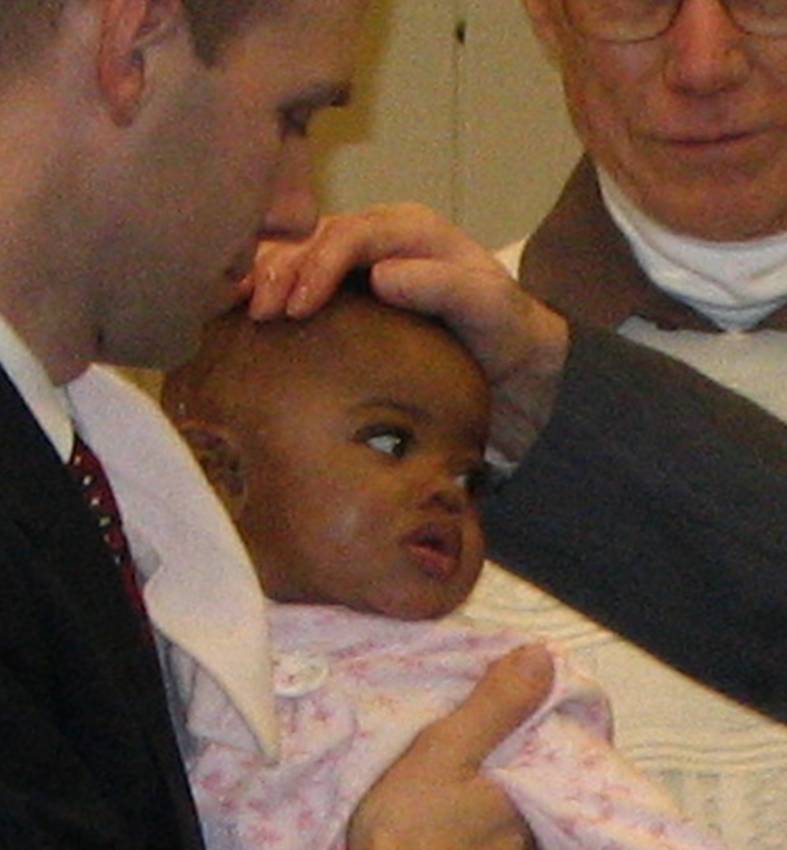
Looking in faith to the Lord Jesus Christ for Faith's salvation, today we unreservedly dedicated Faith to God and promised, in humble reliance upon divine grace, that we will endeavor to set before her a godly example, that we will pray with and for her, that we will teach her the doctrines of our holy religion, and that we will strive, by all the means of God's appointment, to bring her up in the nurture and admonition of the Lord.

Saturday, February 25, 2006

A Desirable Partner

Kristin and I watched the BBC’s production of Pride and Prejudice recently. Think what you will, but I enjoy Austen’s work immensely. And it turns out I like the movie, too. There are a couple of events from the movie that I want to comment on.

First, we are given a manly example of repentance by Mr. Darcy after his marriage proposal to Elizabeth is flatly rejected. His repentance is lasting, costly, selfless, motivated by love, and transformational. Men who struggle with taking initiative and bearing responsibility would do well to study and emulate his example.

But the part of the movie I enjoy the most is the series of vignettes during the wedding sermon near the end. The snapshots of poorly matched marriages powerfully illustrate – with non-examples--the real purposes for matrimony.

We’re at a season in life where most our peer group has married, and many are well into the child-bearing years. Thankfully, only one marriage that we know of has ended in divorce. Yet, I doubt that few of us at the time of our betrothal were mature enough to make such a momentous decision in view of biblical purposes for matrimony.

God’s grace is very evident in the match between Kristin and me. I was certainly not mature enough to comprehend the magnitude of the decision I was making when I proposed to her that night along the Riverwalk in San Antonio. But God has given me a wife that, even to this day, is better than I deserve. “Now to him who is able to do immeasurably more than all we ask or imagine,” I give my heartfelt thanks.

Friday, February 24, 2006


Surprised By Scripture

I've been surprised by what I find in Scripture several times recently.

Psalm 73 Here prosperity is called a "slippery place" vs 18 where God intentionally sets the wicked until the moment when He suddenly sweeps them away. Riches among the ungodly are a cause for pity rather than envy.

Jeremiah 3:14 What's frightening about this verse is that God says "I will take one from a city and two from a family." The context is a call to repentance to the faithless among God's covenant people. I wonder if verses like this explain why some Calvinists think that God will save very few and condemn the majority?

2 Corinthians 4:7-18 This beautiful passage on bodily suffering is surprising because so little of its sentiments are expressed by Christians today whose "outer nature is wasting away". How hard it is for us to believe that "we have this treasure in jars of clay" for a reason.

Thursday, February 23, 2006

Good Advice for Church-goers

"Keep your head down, and try to be faithful. Don't analyze too much."

This is the tactic of a man I admire who has faithfully served the same church for 15 years here in the hard-to-grow Southwest. The remark about 'don't analyze too much' means don't do things like fret over why the liberal churches continue to grow at a faster rate than the biblical ones, etc. Just try to be faithful, trusting God's sovereignty over all things.

This is more than good advice for pastors--I ought to heed it, too. What is called for in the local church is a servant and not an analyst who stands aloof while pointing out the problems he sees.

Monday, February 20, 2006

Lunch at Model's Pharmacy

Roadfood hasn't let me down yet. This book (now a website, too) finds the best backstreet mom and pop restaurants across our country and shares the news so we can enjoy them, too. Today we had a great lunch at Model's Pharmacy.

They serve breakfast and lunch with a refreshing side of local culture. How delightful to get away from the same chains and enjoy some simply delicious fare. Located near the base, if you're in the area, Kristin and I highly recommend stopping in for a bite!

Sunday, February 19, 2006


Sunday Morning Climbs

I need help climbing Mt Zion on the Lord's Day. My help has to be patient and strong; I'm a slow climber and the trek to corporate worship can put me in the foulest mood.

What I have found to be a great help in that climb is the lectionary readings for Sunday mornings. Week after week it provides surprisingly strong aid for the ascent. For instance, this morning's readings comprised short selections from the Psalms, Joshua, Ezekiel, Deuteronomy, Proverbs, 2 Timothy, Matthew, Luke, and Mark. Each passage lent a strong hand in getting me properly up to Mount Zion.

My other faithful trail guide is the Valley of Vision. This morning I was prayerfully reminded,

this is thy day,
the open door of worship,
the seal of the sabbath to come,
the day when saints militant and triumphant unite in endless song.

The veil is torn aside and I find thee ready to hear,
waiting to be gracious,
inviting me to pour out my needs,
promising to give more than I ask or think.

I'm not going to miss that. Let's get up that mountain.

Saturday, February 18, 2006

When Peace Yields to Faith

Many Christians hope for a nice, quiet life. It's a biblical hope (see 1 Tim 2:2), but interestingly, the "hall of faith" (Heb 11) contains not a single account of a peaceful and quiet life.

To reconcile these two -- a desire for peace with the violent reality of a life lived by faith -- there seems to be a point where to be peaceful is to be unfaithful. At some point peace yields to faith.

The faith chronicled in Hebrews 11 is both passive and active. It's passive faith to suffer mockings and floggings, to be killed with the sword, to be tortured. But faith is to be aggressively active too; it puts foreign armies to flight, conquers kingdoms, receives back the dead, enforces justice, obtains promises.

I desire a quiet, peaceful life. But there will be situations where I must choose: peace or faith. At that point, peace is cowardly and treasonous. And not becoming of those whom the world was not worthy.

Wednesday, February 15, 2006

If it Sounds like a Duck, then...

I had another meeting this week with my co-worker who is a Mormon. He is interested in knowing why I will not consider Mormonism part of the Christian faith. I identified the essential doctrines of the Christian faith and used examples from Mormon doctrine that show that they reject the correct understanding of the Trinity--in other words they deny the true God.

To obfuscate their position the LDS plays word games, very similar to how modernists have treated the Christian faith since the 19th century. For instance, the LDS uses the term Trinity but gives it a very different meaning. Instead of "one God existing in three eternal persons", they define it as "an office held by three distinct Beings who are one in purpose and intent, perfectly united to comprise one Godhead."

My friend could see the difference but considered it only semantics. I argued that it was not semantic since this is an essential doctrine of the faith, and that to reject a correct understanding of Trinity could make one guilty of idolatry and blasphemy.

The question I left him with is whether the Mormon faith is polytheistic, even though it claims not to be. I don't believe the LDS would ever admit to being polytheistic, but it sure sounds to me like they are.

Thankfully, this was a civil discussion and we are to continue talking.

Saturday, February 11, 2006

Still True?

It ought to be more carefully considered, that all men promiscuously do homage to God, but very few truly reverence him. On all hands there is abundance of ostentatious ceremonies, but sincerity of heart is rare.

That's a quote from Calvin's Institutes (Book 1, Chap 2). Is it still true that all men do homage to God?

My answer: our age is one of radical informality, so there is no longer "an abundance of ostentatious ceremonies"--although the church-growth movement still attacks formality as if it is the problem. What has changed is that even the "sincere in heart" see little need for ceremony, so that neither God-rejecters nor God-lovers truly reverence him.

Wednesday, February 08, 2006

Disappointment in Virginia

I've been reading tonight (while in Seattle on business) of the sad affair -- and ugly mess -- that has occurred at St Peter Presbyterian Church where R.C. Sproul, Jr pastors.

I suspect this is not the most objective account of the defrocking and dismissal of Sproul Jr (and the session) from the denomination to which they belonged, so I will avoid commenting on the pastoral practices of the session and limit comments to an area that hopefully avoids potential for slander.

Why did so many families move across the country to rural Virginia to join a church? Many of them went to such great expense in order to be part of a vision that offered a simple, separate, and deliberate lifestyle, focusing heavily on family and community.

I believe this is a good vision based on biblically-important principles. For a brief time, I considered moving my family there. I have a stack of Basement Tapes. But a couple of conditions make the St Peter community ripe for strife. First, expectations of the movers are bound to be high, dangerously high. People who give up much in order to gain a certain lifestyle will be tempted to feel cheated by empty promises if reality doesn't match what they imagined from listening to tapes and reading articles.

But the bigger problem may be doctrinal. This could prove to be a classic case of majoring on minors. While lifestyle and community are important, they don't rise to the level of the essentials of the Christian faith. If they are exalted to that place, one tends to become opinionated and unloving. Reading the complaints of several members, there were significant theological disagreements with the church's leadership, but the families chose to move there anyway, ostensibly for the lifestyle. This shows the importance of doctrinal agreement and the destructive power of doctrinal differences.

Disappointing to say the least.

Sunday, February 05, 2006

Once Deceived, Twice Shy

A recent friendship, that I'm afraid has come to an end, has taught me to be more considerate of the difficulties that come with leaving a cult. My friend grew up in the RLDS (associated with Mormonism) but came to realize this was a false church many years ago and left it. Painfully aware of how thoroughly he had been deceived, he is very sensitive about being deceived again, and for years this has kept him from becoming part of any church.

He recently made attempts to become part of the church I attend, but a host of issues has led him away from any assembly. His path is a lonely one; separated from a community of redeemed sinners, alienated from the visible church, and her means of grace.

I believe my friend is sincere when he says his desire "is to bring honor to the Word of God and the purity of the gospel of Christ." But his desire is unachievable apart from the visible church since Christ came to join us to himself and to one another as his body, the people of God. We are not to be individual points of light in the world, but a city set on a hill. We are not to give up meeting together as some are in the habit of doing (Heb 10:25).

In a fallen world we shouldn't expect purity, and this includes in the church. But for my friend, it appears that some of Joseph Smith's lies have yet to be rejected: the witness of the Christian church is so impaired that we must separate from it.

I do have pity for my friend and those in his situation. To be deceived by a cult is painful enough. Doing your best to avoid being tricked again makes sense. But I fear that going alone is just as dangerous a solution.

Saturday, February 04, 2006

Causing Offense

I've written before about a Mormon I work with that has initiated a discussion with me about whether Mormons are Christians. As I was leaving work for the day yesterday, he came to me again and we spent an hour going over what defines a Christian and if the Mormon faith is a reasonable faith.

It was a civil discussion until near the end. Once he realized that I did not accept his attempts to refute my arguments and would not consider him a Christian, he with a flushed, angry face told me he was offended and off-loaded on me for a few minutes. At one point I had the suspicision he was thinking of striking me.

It will be awkward to continue working with him every day.

Thursday, February 02, 2006

Giving Up the Love of God to Become the Sin of Men

Last Sunday's sermon pointed out to me
that the Son loves most His Father's charity.
In this he has delighted, ere the worlds began to be.

But from all eternity, there came a time in Galilee
when the Son willingly ended His Father's love to become iniquity.

"Son of God, come down from the cross," mocked the Pharisee.
O how close did this agree with the prayer at Gethsemane,
"My Father, if it possibly be, let this cup pass from me!"

To give up what you love most, to become what you most hate;
the love of God for the sin of men; the Son's sacrifice so great!

It was not only the Son who was tempted to bend,
one appeal to the Father--twelve legions of angels He would send.
Rescue my only Son, damn the world of sin!
O how close did the plan come to an end.

To give up what you love most, to redeem what you most hate,
the love of God for the sin of men; the Father's sacrifice so great!

Sunday, January 29, 2006

Early (Warning) Signs of Personality

Saturday, January 28, 2006

Chronic Dislocation Syndrome

Church membership either turns you into a servant, or proves to you that you’re not one. Mark Dever

The military lifestyle is a highly mobile one, and I'm convinced this chronic dislocation is more likely to make you a church consumer than a church servant.

Most of our military friends that are Christians are not church members. They can't decide which church they like and so they discontentedly float between large churches for months or even years. Over the last several months, we've invited at least 8 of these families to church with us. All of them have politely turned us down.

It ain't easy being a little church. Tougher still if you're little and Presbyterian. Our church is both those things. It's for servants--not consumers.

Friday, January 27, 2006

Repeating Pilgrim's Progress

Every other year I find my way back to Pilgrim's Progress. I finished it again last night. Each time new characters stand out from the rest and I make better sense of what Christian is saying during some of the longer conversations with Hopeful.

But I wonder, if Christian's descendant, call him Christian the VI, were to enter yonder wicket-gate today who would he meet with on the way? Many of the same misinformed folks and scoundrels, I suspect. But there probably would be some new acquaintances.

Mr. Therapeutic, Mr. Nice, and Messrs. Sweet and Sentimental, all of the town At-Ease, would be traveling along the way. Surely the way must also pass near a great university where Christian, VI would encounter the aged Dr. Higher Criticism and the always youthful Dr. Po-Mo.

Interestingly, Christian today has no need of different friends than his ancestor enjoyed. Evangelist, Faithful, Hopeful, and the refreshment provided by the Lord of the way still supplies all a Pilgrim needs.

Now, reader, I have told my dream to thee,
See if thou canst interpret it to me.
Sunday, January 22, 2006

Sola Scriptura Requires More than Scripture

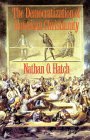
The title of this post sounds nonsensical, but I hope the brief words that follow prove it true. This post continues some thoughts on The Democratization of American Christianity.

In an elders' meeting a couple of years ago we were wrestling with several theological issues and there application in our church. I thought it appropriate to recommend we look to church history for assistance, but the senior pastor felt otherwise. He remarked that the problem with creeds, confessions, and the like, is that you don't know which ones to use because they're not infallible. In effect, you have to read the Bible as if it just dropped from the sky and you're the first person in the world to pick it up. To him this is what Sola Scriptura means.

The problem with this approach, which is all too common today, is that we can't escape coming to the Scripture with our own set of prejudices and ideas. We do not possess a "clean slate" for the Bible to write upon.

This problem is not unique to us. The authors of creeds and confessions had the same problem, but since they lived in a different time and culture, their prejudices were in different areas than ours. So here is one reason why creeds and confessions can help us with Scripture interpretation; their blind spots are different than ours.

So for us to approach our faith Sola Scriptura, we must overcome our prejudices. Our fathers in the faith can serve us in that regard. And since the Bible has been honored, interpreted, and applied faithfully by our fathers in the faith, we would be foolish not to take their reflections into account.

Friday, January 20, 2006


The American Devolution

Several folks I respect recommend The Democratization of American Christianity as a way to understand how American Christianity became audience centered, intellectually weak, organizationally fragmented, and popularly led. But don't think the book is one-sided. It also explains why American Christianity maintains a strong presence in our culture, forging moral communities that give meaning to ordinary people. I will limit this post to summarize only a small part of Hatch's impressive scope of research and analysis.

The impression given by the book is that what happened to American religion in the early years of our nation is a case of generally understanding a problem correctly, but reacting with a terrible solution. The problem was found in the form of Calvinism so pervasive at that time. It permitted no means of spiritual release (i.e. no emotion or place for personal experience), was preoccupied with arcane theology and complicated controversies, often endorsed the status quo regarding social classes and slavery, and was full of clergy that couldn't relate to the common man.

The reaction to these problems was much worse than the problem itself. Drunk on dreams of democracy and individualism, American Christians in their passion for religious liberty exalted the individual's judgment over all creeds, catechisms, and confessions. In essence what was attacked was theology and the need for an educated clergy. All the weight of church history and theological argument could not withstand the power of the declaration, "No Creed but the Bible." What we failed to realize is that our aversion to religious authorities and historical underpinnings, and our exaltation of private judgment, only created more and more disunity and discord in the church. Could God be the author of such confusion?

And this has become America's characteristic defect. We possess an unstable compound of religious zeal and private judgment that continues to split churches and create an endless number of denominations. Religious innovators in America have rarely been denied a receptive audience. We are a land of ten thousand Reformers, and each one has his own church.

Tuesday, January 17, 2006

A Strange Lack of Desire for the Future

Children, our future, are perceived as a threat to the present, as though they were taking something away from our lives. Children are seen--at least by some people--as a liability rather than as a source of hope.

Benedict XVI in First Things

Monday, January 16, 2006

Impotent Morality

Ken Myers in volume 77 of the Mars Hill Audio Journal makes a telling remark on morality. Speaking from the perspective of the pragmatists, he says,

We want the morality, but we don't need to worry about any kind of transcedent source for it. We'll just work up some rules to ensure the morality happens.

Those of us who suffer through ethics training know this to be true all too well. The pragmatic approach fails because fallen mankind cannot live up to the ideal. We are regularly hunted by the evidence; rules don't prevent scandals.
Old and Young

Kristin and the children went to a community craft center during homeschool recently. A group of older women were also there, and they repeatedly made it clear that they didn't like children around them. After several rude comments, Kristin and the children decided to come back another time.

We naturally have a bias towards our own demographic. For me, this bias manifests itself in who I seek out after church as well as who I seek to invite to church. This may explain why some churches are filled with young families while others have nothing but the older set, and vice versa.

In my private worship this morning, Zechariah had this to say speaking of the holiest, best days of Jerusalem,
Thus says the Lord of hosts: Old men and women shall again sit in the streets of Jerusalem, each with a staff in hand because of great age. And the streets of the city shall be full of boys and girls playing in the streets. (Zech 8:4-5)

I take this to say that it is marvelous in the Lord's sight (vs 6) when His people, old and young, look beyond their own demographic and enjoy being together with each other.

Friday, January 13, 2006

Good Fences -- Doctrine Defines, and Yes, Divides When Necessary

Christians today seem to think someone is a Christian based on an experience they've had ("I asked Jesus into my heart"), or their morality ("I don't watch Desperate Housewives"). They neglect the role that doctrine should have in defining Christianity. A couple of events from this week reaffirmed to me why we must know what we believe.

I was given an opportunity to explain the Gospel to a Mormon co-worker yesterday on the way back from a luncheon. He felt that Mormons were Christians because he believes he is saved by grace through faith.

I agreed that we have similar salvation language, but the problem is, we have different Gods. He thought I was overemphasizing what is really just semantics about deity. I then explained the need to define what is Christian faith, and used the Nicene Creed to do so. I explained how it says that the Christian God is a triune God and defines what that means. He responded, "then by that definition I am no Christian." Interestingly, he came back to my desk today with a statement from the LDS prophet that says that they do not affirm the Nicene Creed, yet they are Christians. Well, one of us has the wrong definition of Christian! And I hope to continue the discussion.

Another event happened this week to Kristin that also shows that we must know what we believe. She was having dinner with a couple of ladies from our neighborhood who were talking about a Muslim neighbor. One of the ladies, who professes Christ, said that the Islamic lady and her have talked and they can't find any real differences in what they believe.

Creeds, Confessions, and Catechisms have been used by the Church for centuries to define what is the historic, orthodox Christian faith. Christians today would be well served to better acquaint themselves with them.

Tuesday, January 10, 2006

Spending Time with Giants

A friend and I met for lunch today to discuss Jonathan Edwards' Unpublished Essay on the Trinity, written sometime in the 1700s. Edwards' main point was that the Word of God teaches us more things concerning the Trinity than have been generally taken notice of. In in a very compact way he goes higher up and further into this most mysterious of divine mysteries. Among other things this is the best teaching on the Person of the Holy Spirit that I've ever read. And his writing is not dry as dust nor highbrow, but instead is richly devotional.

But the Trinity is not my point in this post. This is a lament against modern books. If you've got a few minutes read just the first 100 words or so of Edward's essay and compare that to the same amount of text in a typical theological work of today. Edwards says vastly more in a few paragraphs than modern authors usually convey in whole books. If you want to discover more glorious and exceedingly wonderful things in your reading, make time for the giants of the past.

Saturday, January 07, 2006

Epiphany Gifts

Exchanging gifts on Epiphany (6 Jan) is a tradition in our family. Each gift is selected with the intent to help another love Christ more. The children got a new Story Bible. I gave Kristin a sabbatical at a local Bed and Breakfast. Kristin delighted me immensely by getting me a seat at Ligonier Ministries' National Conference in Orlando this March! This year's theme is the church; I can't wait! Are any of you planning to attend?

Wednesday, January 04, 2006

A Plea to Re-think China Adoptions

I'm in Seattle this week for business, but I enjoy talking to Kristin each evening. She tells me we received another urgent phone call from an adoption agency desperately looking for a home for a soon-to-be born baby. Before we took our name off the lists (after adopting Faith) we received several phone calls like this every week!

If I can be less-than-nice for a moment, I know several families who are waiting to adopt from China despite that country's recent decision to delay processing applications for adoption for up to one year. So we have the deplorable situation where families who want to adopt, who have their home study done so they can adopt, are waiting for over a year for a baby from China while the fatherless and needy infants of our own country go without Christian homes!

At this risk of judging motives, I think Christians have too heroic a vision of rescuing babies from China. Indeed, it is in vogue now in parts of the Christian community. But while they wait and wait while China dallies around and takes their money, they are effectively denying Christian homes to many needy children in the States. Adopting domestically, if you look outside the Caucasian race, is ordinarily cheaper, quicker, and easier!

If providentially you know a family who is ready to adopt, and would consider what I've said, have them contact me. The baby we heard about today is due early March, and she doesn't have a home.

Sunday, January 01, 2006

2005 in the Books

Each New Year I post what I read during the year just ended. The last couple of years have been meager ones, mainly due to tending to schoolwork in the evenings or moving. But with a break in Air Force schooling (and moving!), I'm hopeful to cover more (and better) ground in 2006. Anyway, here's a list of the books read in 2005 (not counting the Bible or what I read to my children) with a brief analysis at the end.

- Call Of Duty, the Sterling Nobility of Robert E. Lee; Steve Wilkins
- The Cross-Centered Life; C.J. Mahaney
- The Spirituality of the Cross (i.e. Lutheranism 101); Gene Edward Veith
- The Foolishness of God (i.e. is the law of non-contradiction biblical?); Siegbert W. Becker
- Age of Opportunity (parenting teenagers); Tedd Tripp
- Against Christianity; Peter Leithart
- Gilead (twice); Marilynne Robinson
- Plowing in Hope, towards a theology of culture; David Hegeman
- To Conquer the Air (bio of Wright Bros); James Tobin
- Reformed Theology in America, a history of its modern development; David Wells, ed.
- Ministries of Mercy; Tim Keller
- Pickwick Papers; Charles Dickins
- Rare Jewel of Christian Contentment; Jeremiah Burroughs
- Confessing Christ (used in new members class at church); Calvin Knox Cummings

Looking at this list overall, I'm pleased that I read several biographical works, that I read some theology outside of my tradition (e.g. two Lutheran works), and that I read quality fiction (i.e. Dickens and Robinson). I'm not satisfied with the amount of reading of books written outside of my time period or outside of the Christian faith. So in 2006 I will try to read more books that are older and also make time for some non-Christian non-fiction (e.g. like Postman, etc).

Saturday, December 31, 2005

Such a Swarm of Prejudices

I re-read a portion of puritan Isaac Watts' Logic this week at the request of a friend. In this section Watts details the sources of error in our judgment which largely stem from the fondness we have for ourselves. In a most powerful way he reveals the devastation our prejudices have on a right understanding of Scripture. I'll add that American Christians, with our individualistic and anti-authoritarian tendencies, need to pay special heed to this rebuke. Some of Watts' excerpts,

We set up our own opinions as tests of orthodoxy. We ought to bring our minds free, unbiased, and teachable, to learn our religion from the word of God; but we have generally formed all the lesser as well as greater points of religion beforehand, and then we read the prophets and apostles, only to pervert them to conform our own opinions.

We become sharp-sighted as to find our own opinions in those places of Scripture where the holy writers never thought of them, nor the Holy Spirit intended them. At other times, our prejudices bring such a dimness upon the sight that we cannot read anything that opposes our views, though it be written with sunbeams, and in the plainest language [Watts cites Luther on the Epistle of James, Catholics on the Apocyphra].

If the common text be not favorable to our opinion...the common understanding most be supposed to be defective or redundant, and the sense of it shall be literal or metaphorical, according as it best supports our own scheme. We are ready to find something in every chapter of the Bible to countenance our own private sentiments; and we love those chapters best which speak our own opinion plainest.

I believe our prejudices largely explain the disunity of the Church. The solution? Watts again: "Since we find such a swarm of prejudices, the weakness of our reason, our insufficiency to guard ourselves from error, we must direct ourselves to Heaven, and implore the God of truth to lead us into all truth, and to ask wisdom of Him who giveth liberally to them that ask it."

Thursday, December 29, 2005

Chaplain Tim Bailey?

Back in 1993 when I was new to the Air Force, and new to the Christian faith, I spent a good deal of time with an Air Force Chaplain whose background was African Methodist Episcopal. He believed in prophesying and he believed in me. He told me that one day I would be an Air Force Chaplain, he knew it, and he was never wrong about these things. Thankfully, wrong he was.

A friend of mine from the Air Force, who's not a chaplain, sent me a copy of the new talking paper on the "Interim guidelines of religious expression in the Air Force." A couple of the new guidelines make sense, but most are horrid, especially if you're a chaplain.

Consider its recommendations on prayer. "Prayers may be offered at military holiday parties. If a prayer/meditation is to be offered, strongly recommend that unit Chaplains be utilized to provide the prayer/meditation. Key point: The prayer/meditation/reflection should not be specific to any faith group." Then the following sample prayer was provided,

Dear Lord, as the days of winter grow shorter, our hearts seem to yearn for the coming light, explaining our Holiday Season focus on decorative lights and candles. And as we focus on the coming light that this season represents, allow our light to shine in our world. Allow our good works to shine before men so that they may be encouraged. Amen

I detest these empty prayers and empathize for the Chaplains that are forced to pray to this therapeutic deity of our own making. Thank the Lord Jesus Christ I'm not one of them.

Tuesday, December 27, 2005

Love Must Be Expressed Through Word and Deed

My church is surrounded by growing numbers of people in need. Situated fairly close to the "bad part of town", a deacon recently told me that more than once the after-worship refreshments have been stolen during the service by people off the street. And there have been some tense moments during the week when emotionally-unstable people have entered the building demanding a hand-out.

I suspect most churches in large cities are regularly solicited for financial assistance from people in need. I also suspect that many of these people will abuse whatever assistance is provided. Perhaps this explains why many evangelical churches are much stronger on Word ministries (e.g. teaching, evangelism) than they are mercy ministries.

So I was intrigued when a deacon at our church taught the adults from Tim Keller's book. Dr. Keller is pastor of Redeemer Presbyterian Church (PCA) in Manhattan, and he confronts the evangelical church over its lack of mercy, pointing out that mercy is not optional or additional to be being a Christian.

This is a bold book. In many places Pastor Keller gives names of those in the church that get this wrong (e.g. Sider and Chilton are both criticized) and shames the Left with its redistribution of wealth theories and the Right for its assertions that economic growth alone will mend broken families. He shows that only the ministry of the church can properly attack the root of the problem because "the spread of the Kingdom of God is more than simply winning people to Christ. It is also working for the healing of persons, families, relationships, and nations; it is doing deeds of mercy and justice."

Most valuably, this book not only convinces you of the orthodoxy of mercy ministry, aptly answering all the objections to it and also shaming the church for its negligence, but also spends many chapters describing how to go about it.

As a result, our little church is stepping up its participation with several rescue missions in town, expressing our love for our neighbors through Word and deed.

Sunday, December 25, 2005


"The Way to Contentment is to Add Another Burden"

This will be the last book I read this year. It will also be the best.

Do you have a deep satisfaction with the will of God in all things? Do you maintain an inward, quiet, gracious frame of spirit no matter the situation? Or do you murmur? Do you complain at every cross and affliction in your life, dwelling on what discontents you, but unable to meditate more than a moment on God's mercies to you?

Rare Jewel was written by the Puritan preacher Jeremiah Burroughs and first published in 1648. In that era puritan authors wrote with a style of all meat, no fluff. This is a book to savor one paragraph at a time for weeks. If you do so, by the end of the book you will know the cause of your discontentment, and its cure.

Wednesday, December 21, 2005

Is This a War Worth Fighting?

...the War Against Christmas, that is. I'm going against most of pop-evangelicalism and saying that the battle against "holiday trees" and the like is largely a distraction from the real issues of religious liberty.

The Christians I work with are on the warpath because our base newspaper calls it a holiday tree and the Commander says 'Happy Holidays' instead of 'Merry Christmas'. Renaming a Christmas tree is certainly silly, just imagine if we started calling a Menorah a Holiday Candlestick! If we do live in a pluralistic society then there should be enough room in the public square to call a rose a rose. It is a Christmas tree.

But I don't think that the War against Christmas is a major battle for religious liberty. I'm more concerned about recent court decisions forcing some Christian schools to use state-sponsored atheistic curriculum and forbidding some Christian organizations to hire and fire based on Christian morals.

Sadly, there is much less awareness among my Christian co-workers about these issues. And most distressing, there is no angst whatsoever that some of their own churches have called off worship this Lord's Day. This seems like a clear case of keeping the traditions of men while ignoring the commands of God. And that is a battle worth fighting over.

Monday, December 19, 2005

Ordered, Adjudged, and Decreed

Here we are earlier this month with the judge in Alabama that finalized our adoption of Faith. It was a very simple proceeding; we're thankful for that. Since then the days whizzed by with little time to write. I've also been trying to finish three more books by year end; I now have one left. I enjoyed Ministries of Mercy by Tim Keller and hope to post some thoughts on it pretty soon. I also finally wrapped up Dicken's first novel, The Pickwick Papers. Nearly 800 pages long, it's an amusing tale and an amazing feat for the 24 year old author!

Friday, December 02, 2005


The last step

We're off tomorrow to Alabama to finalize the adoption at a court proceeding. At this point we don't expect any difficulties, and we're looking forward to spending over a week with family.

Monday, November 28, 2005

Improving Family Worship

I want to be careful what I teach my children through the practice of family worship. Learning to sit quietly while the Bible is read, or prayers are said, can be a significant accomplishment for little children, but not if they've only learned to tune out what's going on. Good manners are not the end, but a means. What I want out of family worship is for them to have a focused quiet, like the kind that occurs when eating a favorite meal and all you hear is the work of the fork and spoon.

I've noticed for some time that we've lacked the focus and the enjoyment of mining the Word of the Lord during our times of family worship. Now that my two older children can read well enough, I've taken some steps to try to remedy that.

I've explained to them the ACTS (Adoration, Confession, Thanksgiving, and Supplication) model of prayer, and on a small whiteboard I have a column for each category. As the children listen to me read through the Scriptures, I instruct them to tell me things to write down on the board for each area. This forms a large part of our prayer list each evening.

This approach, I pray, will show my children that God's Word is not to be read passively, nor to be read merely as stories, but every time you read the Scripture, you ought to lay your hand upon it and say, "It is mine, and I am to live upon it."

Saturday, November 26, 2005


Happy New Year!

Am I early? Not if I'm reading my lectionary right. The first week of Advent begins tomorrow, which begins the new year on the church calendar.

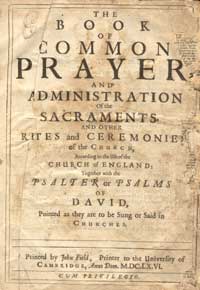
This has been my second year using a lectionary based on the Book of Common Prayer from 1662 for my private Bible Study. Of course there's nothing wrong with reading the Bible from Genesis to Revelation, but when I used that approach I disliked spending all my devotion in only one book of the Bible. The lectionary approach keeps you in several books every morning and evening. For instance, here's today's reading:

Morning
Ps 124, 125
Gen 35:1-20
Matt 13:1-17

Evening
Ps 119:97-112
Isa 42:1-9
Rev 21:22-22:5

I can't find the exact one I use on-line; but here's a recommendation for trying it out.

Thursday, November 24, 2005

The Forgotten Call for Humble Penitence

As a thought experiment I googled a few key Thanksgiving Day proclamations with the intent of comparing them theologically. I sampled Plymouth Colony's First Proclamation of 1676 (although some historians question the validity of the source document) , President Washington's 1789 proclamation, President Lincoln's of 1863, and President Bush's of 2005.

Most strikingly, the 1676 proclamation doesn't mention thanks for an abundant harvest at all; rather, it expresses gratitude that the Lord did not totally consume them with afflictions. It's also a call to consecration, "in view of God's returning mercy," so that the Lord may behold them as a people "sensible of God's afflictions."

Washington proclaims a special day of thanks in part to, "beseech Him to pardon our national and other transgressions." Lincoln calls for a "humble penitence for our national perverseness and disobedience."

Regrettably, somewhere along the way, the call for humble penitence is lost. Recent Presidents, including the current one, make no such request of the American people. No connection is made between national afflictions and God's hand. From President Bush's proclamation, all we ask of God now is that He "watch over us", give us His "special blessing", and "guide us as we move forward." We are a people no longer sensible of God's afflictions.

Tuesday, November 22, 2005


Growing in Years, Growing in Grace

Our daughter Grace celebrated her 6th birthday this week. She invited a few friends from the neighborhood to our house for the evening.

Her new friendships have brought with them a mixture of blessings and trouble. But we pray with confidence that she will love whatsoever things are true and pure and lovely and of good report, following the example of her Savior Jesus Christ. And she does already, to a degree. Today I walked into her room and found her working with her 3 year old brother on his Scripture memory--that's encouraging!

Sunday, November 20, 2005

Pie and Praise

One of the beloved traditions of our church occurs on the Sunday evening before Thanksgiving. The church comes together to enjoy homemade pies and fellowship and then spends the remainder of the evening publicly thanking God through prayer for His goodness to us over the last year. This has been going on for 15 years. It is refreshing to be part of a church body that, despite being geographically separated by long distances, enjoys getting together enough to make the drive. And does so pretty frequently.

Sunday, November 13, 2005


What Does it Mean to be Reformed?

In an effort to understand how churches in the same denomination (PCA) can be so different, I picked up this book. It's a collection of essays covering the 3 major strands of the American reformed church: Princeton, Dutch, and Southern Presbyterian. Each background has an introductory essay and 2 or 3 essays on crucial men in that strand and their theology.

To boil down my notes on the book to the length of a typical blogpost, I'll say that the book does a great job explaining the distinctions of the 3 backgrounds in view, but at the end I'm left with the feeling that there's a large group of people that call themselves reformed that wouldn't identify with any of the three groups. It seems there should have been some discussion over the large number of reformed Baptists, or used-to-be-Baptist reformed folks. These are the kind of folks that we most often meet in the PCA and undoubtedly have added to the uniqueness of American reformed theology and practice.
Athanasius Contra Mundo

Desiring God radio aired Piper's biographical message on Athanasius. Here are the points I appreciated the most:
- Why it's worth fighting over doctrine that Christians have disagreed about for centuries
- Loving Christ must include loving true propositions about Christ. So, doctrine is essential in loving Christ.

I hope you get time to listen to it; I recommend it.

Saturday, November 12, 2005


Veteran's Day to a 5 year old

I asked my children what we remember on Veteran's Day. My 7 year old son got it right, but Grace, my 5-year old daughter had a different conception. She said, "we remember those that take care of dogs."

We have since explained to her the difference between a veteran and a veterinarian.

Friday, November 11, 2005

A Question about Helping Neighbors You Don't Know

Our friend Melene, who lives in North Carolina, asked us to pray for a family in our neighborhood that was in serious need. Melene's husband was deployed with our neighbor's husband, who arrived home yesterday and will care for his wife during a very-risky brain surgery.

We hadn't met the family until recently, and so far we've only met the children and their aunt. The aunt, by the way, lost everything in Katrina and now lives here and cares for her sister's 4 children while she tries to cope with the daily pain associated with loss of brain fluid. There are serious needs all around.

This family is Catholic and may be getting assistance from their church; we don't know. So my question is what is the proper thing for us to do?

In addition to prayer, our current plan is to take them a meal and ask if their church is providing meals and other assistance. If they need help, we want to provide it; but we don't want to be too pushy since we're strangers who happen to live near-by. Other thoughts?

Tuesday, November 08, 2005

The Conversion of Man is Real!

There are skeptics of conversion; they think man's nature cannot truly be changed. And there are those of us that for years have longed for loved ones to know the Lord, and to be frank, we have given up on them. How encouraging it was tonight to have at my dinner table a new friend in Christ. He was a sixth generation Mormon (RLDS) who as an young adult left that cult at great personal cost and now embraces the Biblical truth.

What's more remarkable is that his parents left that false faith, too! Even more remarkable is that my friend's father was the State leader of the Mormon (RLDS) church when he left!

The gospel is the power of God for the salvation of all who believe. No matter what age or situation. Take courage, have hope, keep praying for your lost loved ones!

Saturday, November 05, 2005

Outdoor Recreation

We're enjoying an unusually long Fall here in Albuquerque. To celebrate, some co-workers and I hiked 12 miles Friday in the Sandia mountains on the east side of town.


Then this morning, Eli and I, and some neighbors, went for a horseback ride a few minutes from base. You wouldn't want to do either of these activities in the summer, but it was perfect today!

Thursday, November 03, 2005

Nice Quotes

Desiring God is putting message before money...all the conference lectures from this year's national conference are available for free download (here and here). The theme of the conference was Suffering and the Sovereignty of God. Joni Eareckson Tada covers the subject masterfully, and during her address remarks (and here's my paraphrase from memory), "instead of rehearsing our theology with each other, we are to live out our theology in front of others."

Also, one of the books that I have my nose in is Tim Keller's Ministries of Mercy. Sometimes it pays to read the endnotes carefully. That's where I found this great quote from the minutes of the General Assembly of the Presbyterian Church (USA) in 1892,
In the meantime [since we don't have parishes yet], our usages have taught the poor that the State and not the Church is their almoner, but it is high time that it be rescued from this neglect, and restored to its proper dignity as the most ancient and one of the most significant of ecclesiastical functions...The municipal overseer can never be a substitute for the deacon...The Church must prove herself the friend of the workingman. She can and should answer and conquer the communist by the deacon."